Description
BIT was founded in 2017 as a private institution, with various European universities and companies as supporting partners. There are a Department of Engineering and a Department of Science and in 2021, 304 students had been enrolled.
The Burkina Institute of Technology is based on a system of repeated modules, housing classrooms and auxiliary functions, arranged orthogonally to define a rectangular courtyard. The orthogonal layout of modules allows the campus to be expanded incrementally according to its needs. The modules are staggered, so that air can flow through the central void, creating a cool space where students can relax and interact.
The walls are made of cement-stabilised local lateritic clayey soil poured into the one-storey-high formwork and then rammed by a special vibrator. Due to the special mixture, which contains a high content of large particles, it was sufficient to use for stabilisation only 4.5% of cement by mass, which corresponds by volume to 100 kg per m³. The basic mixture contains per volume 57% of soil, 29% of crushed granite 05/15 and 14% of coarse sand. The formwork was removed after 4 weeks.
The roof profiles, repeated regularly, create a dynamic rhythm and form a chimney at the back of each module where warm air can be released. Suspended ceilings, made of local eucalyptus wood, brighten the interior spaces.
During the rainy season, water is channeled into a large underground tank and stored there. It is later used to irrigate the extensive mango plantations on the campus.
Site plan, 1:2000 Source: Kéré Architecture
Ground floor plan, 1:250 Source: Kéré Architecture
Section, 1:250 Source: Kéré Architecture
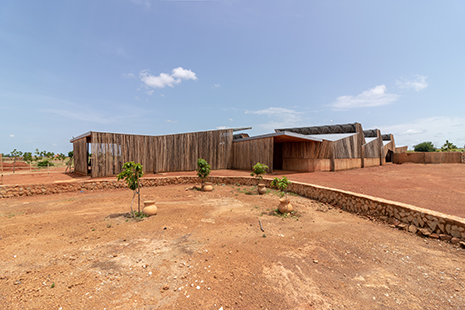
Exterior view Source: Jaime Herraiz/Kéré Architecture
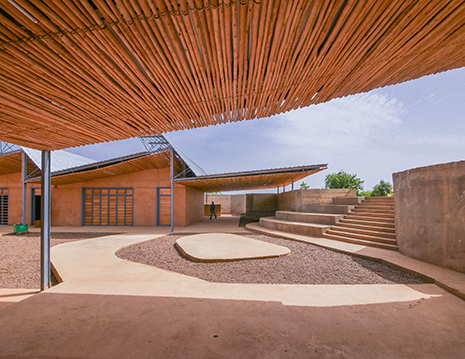
View of courtyard Source: Kéré Architecture
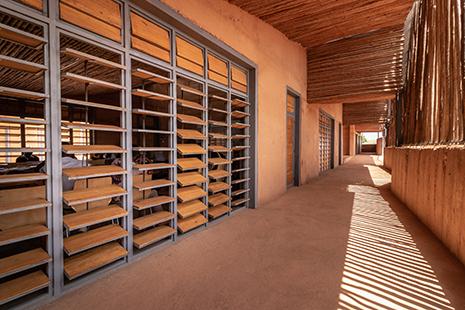
Shaded walkways Source: Jaime Herraiz/Kéré Architecture
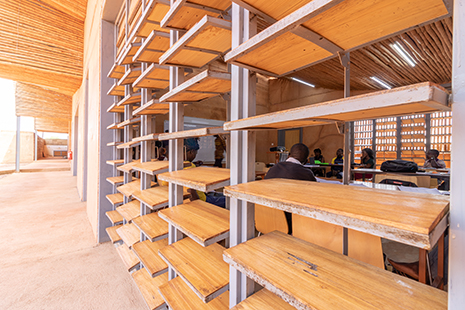
View of classroom through louvred facade Source: Jaime Herraiz/Kéré Architecture
Originally published in: Gernot Minke, Building with Earth. Design and Technology of a Sustainable Architecture. Fifth and revised edition, Birkhäuser (Basel) 2025.